
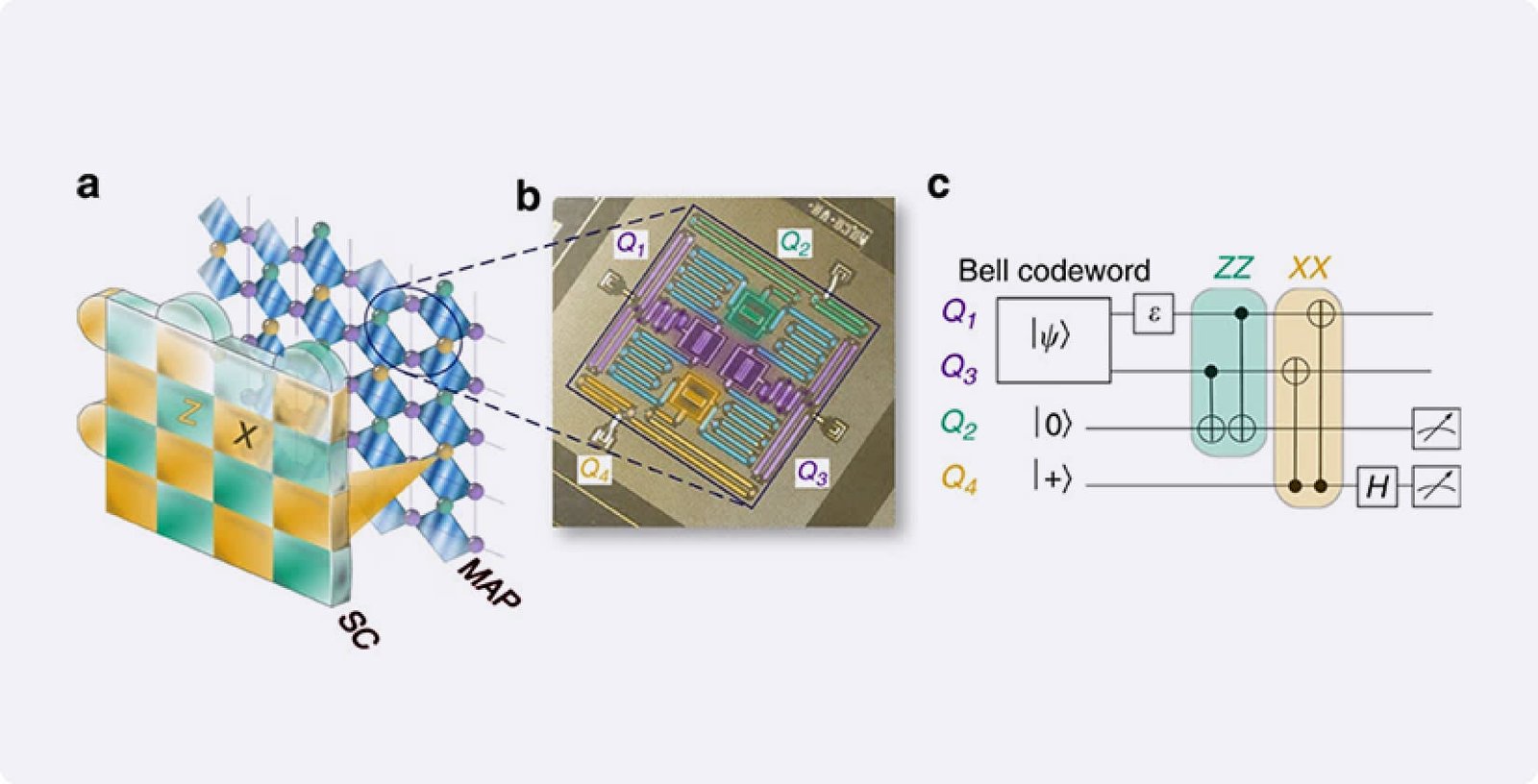
NISQ devices are the first generation of quantum computers that are large enough to perform meaningful experiments but small and noisy enough that error management is critical. They have limited qubits and cannot yet implement full fault-tolerant error correction codes. The term NISQ highlights both their potential and their challenges: they can do things classical computers cannot, but errors and noise are a constant hurdle.
These devices are especially susceptible to decoherence and gate errors. Decoherence occurs when qubits lose their quantum information over time due to environmental interactions. Gate errors happen when quantum operations aren’t executed perfectly. Without some form of error correction or mitigation, complex algorithms on NISQ machines would produce unreliable results. S‑NISQ provides a structured way to manage these issues, focusing protection where it’s needed most and allowing NISQ machines to achieve practical utility today.
How Quantum Error Correction Works
Traditional quantum error correction (QEC) uses logical qubits encoded across multiple physical qubits to detect and fix errors without collapsing quantum states. For example, a single logical qubit may require hundreds or even thousands of physical qubits to be fully protected against errors. Codes like the surface code or stabilizer codes provide high reliability but are currently impractical for NISQ hardware.
S‑NISQ adapts these principles in a lightweight, selective manner. Instead of encoding every qubit, it identifies the critical qubits and operations that would most affect computation accuracy. These targeted qubits receive protection through small error codes or mitigation techniques. This hybrid approach combines classical error detection with quantum error control, giving NISQ devices a better chance to complete complex calculations without excessive qubit overhead.
What Makes S‑NISQ Quantum Error Correction Different?
The key difference of S‑NISQ lies in its structured and selective approach. Rather than trying to achieve full fault tolerance, S‑NISQ focuses on the most sensitive parts of the quantum circuit. This strategy is akin to reinforcing the most important bridges in a city instead of rebuilding every road. By concentrating resources on the most error-prone components, researchers can improve computation reliability significantly.
S‑NISQ also integrates noise-aware mapping. It uses real-time data about which qubits and gates are most likely to fail and assigns critical tasks to the most reliable hardware. Combined with classical post-processing, these techniques reduce the impact of noise on overall computations. This approach provides a practical path for NISQ devices to execute more meaningful experiments than would otherwise be possible.
Key Techniques Used in S‑NISQ Error Correction
Several methods are often employed alongside S‑NISQ to enhance performance. One is zero-noise extrapolation (ZNE), where computations are run at varying noise levels and the results extrapolated to approximate a zero-noise output. Another approach is probabilistic error cancellation, which uses classical algorithms to compensate for errors after measurement. Additionally, small-scale error codes like repetition codes can protect critical qubits without requiring massive numbers of extra qubits.
These methods work together to form a hybrid error correction strategy. While not as robust as full fault-tolerant codes, they allow NISQ machines to handle larger, more complicated circuits than would be feasible with unprotected qubits. By applying these techniques selectively, S‑NISQ balances reliability, resource use, and practicality.
Benefits and Challenges of S‑NISQ Quantum Error Correction
S‑NISQ provides several advantages. It is practical for today’s hardware, reduces qubit overhead, and enables meaningful experiments on otherwise noisy systems. Researchers can test larger algorithms, explore new quantum applications, and gain insights into quantum behavior without waiting for fully fault-tolerant machines.
However, challenges remain. S‑NISQ cannot eliminate all errors and is less effective for extremely long computations. Current implementations require precise calibration, noise characterization, and careful circuit design. Despite these limitations, it represents a bridge strategy, allowing quantum computing to advance while full-scale error correction remains out of reach.
S‑NISQ vs Full Fault-Tolerant Quantum Computing
Full fault-tolerant quantum error correction protects every logical qubit completely and requires thousands of physical qubits. While this is the ultimate goal for large-scale quantum computing, today’s NISQ machines cannot support such codes. S‑NISQ fills the gap by providing partial, targeted protection, which is enough to make computations feasible and useful on existing hardware.
S‑NISQ can be seen as a stepping stone toward full fault tolerance. By experimenting with selective error correction today, researchers learn how circuits respond to noise, which informs future designs. It allows the quantum computing field to progress without waiting for hardware that can support full-scale error correction.
Future Outlook: The Role of S‑NISQ in Quantum Progress
As quantum computers continue to grow in qubit count and reliability, S‑NISQ will remain important for bridging the gap between NISQ experiments and fully fault-tolerant machines. Researchers expect hybrid strategies combining classical processing and selective protection to evolve, potentially improving computation accuracy further. Companies and academic labs using S‑NISQ today gain valuable experience and data that will shape the next generation of quantum hardware and algorithms.
S‑NISQ also provides insights into error modeling, noise mitigation, and circuit design, all of which are crucial for scalable quantum computing. By focusing on what matters most in a computation, it ensures that near-term quantum devices can still produce meaningful results and drive the field forward.
Conclusion
S‑NISQ quantum error correction is a practical and innovative solution to the challenges of noisy quantum hardware. By selectively protecting critical parts of a computation and integrating hybrid techniques, it allows today’s NISQ machines to deliver reliable results. While it doesn’t replace full fault-tolerant error correction, it acts as a crucial bridge, enabling meaningful quantum experiments and preparing the ground for the future of scalable quantum computing.
In simple terms, S‑NISQ makes quantum computers usable today while paving the way for the fully reliable machines of tomorrow. It balances complexity, practicality, and performance—helping researchers, businesses, and enthusiasts explore the promise of quantum computing now, rather than waiting for decades.
Read More: thorn-magazine blog band